Sunday, March 31, 2019
The Fourth Sunday of Lent, Year C
Click here for reflection for readings from Year A

Coming to his senses he thought, “How many of my father’s hired workers have more than enough food to eat, but here am I, dying from hunger. I shall get up and go to my father and I shall say to him, ‘Father, I have sinned against heaven and against you. I no longer deserve to be called your son; treat me as you would treat one of your hired workers.’” Lk. 15:17-19
Por que nos apegamos aos nossos pecados? Esta passagem faz parte da história do filho pródigo. Devemos conhecer bem essa história. O filho decidiu deixar seu pai e levar a parte da herança que um dia receberia, gastando-a numa vida de pecado. Quando o dinheiro acabou, ele passou por extrema necessidade. Então, o que fez? Caiu em si!
Só essa frase já merece nossa meditação. Primeiro, ela revela o que acontece com uma pessoa que cai numa vida de pecado. Neste caso, o filho acabou colhendo os frutos do seu pecado. Percebeu que o pecado o havia deixado na miséria e na solidão. Não sabia a quem recorrer. E, embora nossos pecados talvez não cheguem à gravidade dos pecados desse filho, todos nós experimentaremos o vazio que os pecados que cometemos deixam, assim como ele experimentou.
A profunda lição que podemos aprender com esse filho é que ele de fato mudou de atitude. Mais precisamente, ao “cair em si”, reconheceu duas coisas importantes. Primeiro, percebeu que seu valor era maior do que aquela vida de miséria. Ninguém deveria ter de levar uma vida de pobreza e vazio. Assim, ao reconhecer a própria dignidade, chegou à conclusão de que havia sido feito para algo maior.
Secondly, he knew he could turn to his father. What a blessing it was for him to know this. The reason he knew he could turn to his father was that his father clearly loved him with an unconditional love. The mercy in the heart of the father was so strong that the son was aware of it and this awareness gave him confidence to turn to him.
Reflita hoje sobre essa dupla atitude. O filho reconhece sua miséria e também vê no pai a pessoa a quem pode recorrer com confiança. Devemos nos esforçar para fazer o mesmo em nossa própria vida. O Pai do Céu nunca nos rejeitará. Não importa o que tenhamos feito ou o quanto tenhamos nos afastado, o amor do Pai é perfeito, incansável, incondicional e está sempre a nos chamar. Ele está pronto e disposto a perdoar todo o mal que fizemos, bastando que recorramos a Ele com confiança. Caia em si a respeito dos seus pecados! Abandone-os, arrependa-se e confie na misericórdia de Deus.
Lord, my sins do leave me dry and empty inside. I see the misery and pain that result from the sinful choices I have made. Help me, dear Lord, to come to my senses and to turn from every sin I commit. Help me to see that Your mercy is far greater than anything I have done. I thank You for Your perfect love and turn to You in my need. Jesus, I trust in You.
40 Days at the Foot of the Cross – Reflection Twenty-Five – Jesus Falls
Mais reflexões sobre o Evangelho
Reflexões sobre a Divina Misericórdia
Grace from the Ordinary
The Fourth Sunday of Lent, Year A
(Note: This Gospel is optional for Years B & C with Scrutinies)

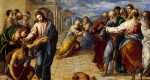
As Jesus passed by he saw a man blind from birth…He spat on the ground and made clay with the saliva, and smeared the clay on his eyes, and said to him, “Go wash in the Pool of Siloam” — which means Sent —. So he went and washed, and came back able to see. John 9:1, 6-7
Who was this man? Interestingly, he does not have a name. He is only referred to as the “man blind from birth.” This is significant in the Gospel of John because the lack of a name is also seen, for example, in the story of “the woman at the well.” The fact that there is no name indicates that we should see ourselves in this story.
“Blindness” is our inability to see the hand of God at work all around us. We struggle to see the daily miracles of God’s grace alive in our lives and alive in the lives of others. So the first thing we should do with this Scripture is strive to see our lack of sight. We should strive to realize that we so often do not see God at work. This realization will inspire us to desire a spiritual healing. It will invite us to want to see God at work.
The good news is obviously that Jesus cured this man, as He willingly cures us. To restore sight is easy for Jesus. So the first prayer we should pray as a result of this story is simply, “Lord, I want to see!” The humble realization of our blindness will invite God’s grace to work. And if we do not humbly acknowledge our blindness, we will not be in a position to seek healing.
How He heals this man is also significant. He uses His own spit to make mud and smear it on this man’s eyes, which is not immediately that appealing. But it does reveal something quite significant to us. Namely, it reveals the fact that Jesus can use something exceptionally ordinary as a source of His divine grace!
If we look at this in a symbolic way we can come to some profound conclusions. Too often we look for God’s action in the extraordinary. But He so often is present to us in that which is ordinary. Perhaps we will be tempted to think that God only works His grace through heroic acts of love or sacrifice. Perhaps we are tempted to think that God is not able to use our daily ordinary activities to perform His miracles. But this is not true. It is precisely those ordinary actions of life where God is present. He is present while washing the dishes, doing chores, driving a child to school, playing a game with a family member, carrying on a casual conversation or offering a helping hand. In fact, the more ordinary the activity, the more we should strive to see God at work. And when we do “see” Him at work in the ordinary activities of life, we will be healed of our spiritual blindness.
Reflect, today, upon this act of Jesus and allow our Lord to smear His spit and dirt on your eyes. Allow Him to give you the gift of spiritual sight. And as you begin to see His presence in your life, you will be amazed at the beauty you behold.
Lord, I want to see. Help me to be healed of my blindness. Help me to see You at work in every ordinary activity of my life. Help me to see Your divine grace in the smallest events of my day. And as I see You alive and active, fill my heart with gratitude for this vision. Jesus, I trust in You.
40 Days at the Foot of the Cross – Reflection Twenty-Five – Jesus Falls
Mais reflexões sobre o Evangelho
Reflexões sobre a Divina Misericórdia