November 17, 2026
Memorial of Saint Elizabeth of Hungary, Religious
Readings for Today
Readings for Tuesday of the Thirty-third Week in Ordinary Time
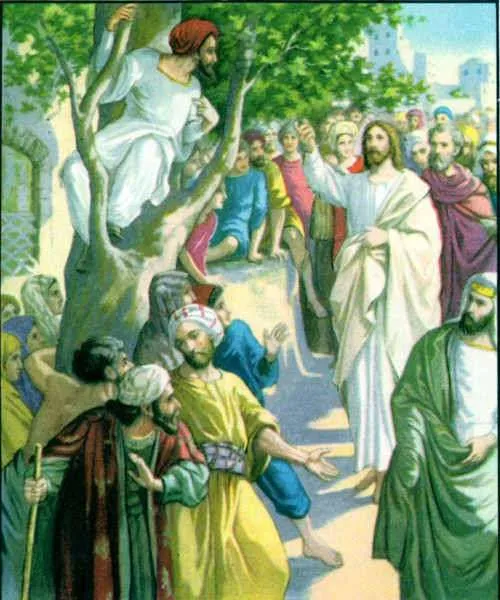 Zacchaeus in the Sycamore Tree, by Otto Semler, CC BY-SA 2.0
At that time Jesus came to Jericho and intended to pass through the town. Now a man there named Zacchaeus, who was a chief tax collector and also a wealthy man, was seeking to see who Jesus was; but he could not see him because of the crowd, for he was short in stature. So he ran ahead and climbed a sycamore tree in order to see Jesus, who was about to pass that way. Luke 19:1–3
Today’s Gospel is drawn from Luke’s Travel Narrative, during which Jesus was “resolutely determined to journey to Jerusalem” (Luke 9:51). That journey would culminate in His ultimate sacrifice by which He offered His life for the salvation of souls. Along the way, however, Jesus drew many disciples, preaching and performing numerous miracles.
Jesus’ journey through the prominent and affluent town of Jericho resulted in two distinct yet complementary moments. First, as He entered the city, Jesus healed a blind beggar. The blind man, upon hearing that Jesus was passing by, cried out, “Jesus, Son of David, have pity on me!” Jesus heard him, healed him, and the man became His disciple.
Inside the walls of Jericho, Jesus called a wealthy tax collector. In contrast to the blind beggar, Zacchaeus, the “chief tax collector and also a wealthy man,” did not call out. Instead, he climbed a sycamore tree to catch a glimpse of Jesus. Yet Jesus, knowing Zacchaeus’ heart from afar, approached him and said, “Zacchaeus, come down quickly, for today I must stay at your house.”
One of Jesus’ new disciples was a poor and blind beggar, the other, a wealthy and influential tax collector. Though vastly different in worldly status, these two men shared something significant: Both were outcasts. The blind man was likely seen as cursed, his condition presumed to be a result of his own sin or that of his ancestors. Zacchaeus, on the other hand, was despised because of his cooperation with the Roman authorities, collecting taxes from his fellow Jews and enriching himself unjustly.
To each, the crowd reacted in a similar way. Of the blind man, “the people walking in front rebuked him, telling him to be silent.” Of Zacchaeus, they “began to grumble, saying, ‘He has gone to stay at the house of a sinner.’”
Most of us struggle with peer pressure, not only the kind that tempts us to sin outright, but also the more subtle pressure to judge, exclude, or look down on others whom society deems unworthy. It is difficult to show mercy when the world demands condemnation. But for Jesus, it was never difficult. He judged only the heart. Whenever He saw faith, He extended mercy, no matter a person’s past or status.
Jesus’ merciful gaze and gracious invitation had a profound effect on Zacchaeus. “Zacchaeus stood there and said to the Lord, ‘Behold, half of my possessions, Lord, I shall give to the poor, and if I have extorted anything from anyone, I shall repay it four times over.’” To this, Jesus responded, “Today salvation has come to this house… For the Son of Man has come to seek and to save what was lost.”
Like Zacchaeus and the blind man, we all need Jesus to look upon us with mercy. But we must also strive to look upon others with the same merciful gaze. Cast aside worldly judgments and social pressures that tempt you to condemn, and instead perceive every soul through the heart of Christ rather than through the lens of what is popular.
Reflect today on how strongly public opinion sways you. Many today often express outrage at others for a variety of reasons. Though objective sin must be condemned and the culprit held accountable, we ought never judge others’ hearts, no matter their actions. Reflect on those whom you tend to judge and condemn; imitate Jesus by looking for faith in their hearts. By doing so, salvation comes not only to your heart, but also invites others to change and become disciples of Christ as He journeys to His Cross.
Most merciful Jesus, You were never swayed by public opinion, especially when it came from the self-righteous. Pour out Your abundant mercy upon me, and grant me a share in Your tender concern and compassion for every soul. May I imitate the love of Your Sacred Heart and become an instrument of Your merciful gaze and invitation to the gift of salvation. Jesus, I trust in You.
Saint of the Day – Saint Elizabeth of Hungary, Religious
Novena to Christ the King
Traditionally Nine Days Prior to the Solemnity of Christ the King
Novena prayed daily from November 13–21, 2026
Scripture Meditations for Ordinary Time