Sunday, March 24, 2019
The Third Sunday of Lent, Year C
Click for reflection when readings for Year A are used

“Sir, leave it for this year also, and I shall cultivate the ground around it and fertilize it; it may bear fruit in the future. If not you can cut it down.” Luke 13:8-9
Every gardener knows that good fruit is, in part, dependent upon the presence of good soil. But other factors are also important in the production of good fruit. The plant must be free of disease, receive water and sun, be planted in a warm environment, be properly pruned, and have space enough to grow. When all factors are present, good fruit is guaranteed.
Il en va de même pour notre vie. La terre dans laquelle nous sommes appelés à être plantés est la miséricorde de Dieu. Et cette terre est la plus riche qui soit pour faire croître les vertus dans notre vie. Dieu nous procure aussi le soleil, la pluie et la chaleur nécessaires à notre croissance. Mais, pour poursuivre cette analogie, nous devons nous laisser tailler. Nous devons aussi laisser cette terre être fertilisée et travaillée de diverses manières. Bien que Jésus soit le Jardinier de notre vie, il est également juste de dire que nous sommes les jardiniers, en ce sens que nous devons coopérer avec notre Seigneur, en nous appuyant sur les ressources surnaturelles du Créateur pour assurer la saine croissance de notre vie spirituelle, afin que les bons fruits de la vertu puissent naître dans notre vie.
Le passage ci-dessus est la conclusion de la parabole du figuier. Juste avant ce passage, le propriétaire de la vigne, Dieu le Père, a ordonné que le figuier stérile soit coupé afin qu’il n’épuise plus la terre. Mais notre Seigneur miséricordieux, envoyé en mission par le Père pour travailler la terre de notre vie, cherche à lui offrir une nouvelle chance, et le Père y consent par amour. Cette vie est cette « année » durant laquelle notre Seigneur œuvre avec ardeur pour travailler la terre autour de nous. Nous devons coopérer par la prière quotidienne, la fidélité à ses commandements, des actes de sacrifice accomplis par amour et l’abandon à sa providence. En fin de compte, si nous laissons notre Seigneur accomplir tout ce qu’il désire, notre vie portera de bons fruits.
Mais, à l’inverse, ne vous y trompez pas : si notre vie ne porte pas de bons fruits, nous serons « coupés ». Porter de bons fruits n’est pas facultatif, c’est une nécessité. C’est un signe clair de notre santé spirituelle, et cela deviendra la mesure de notre récompense éternelle ou de notre mort éternelle. Ne vous laissez pas intimider par ces paroles si tranchantes de notre Seigneur. Il les a prononcées avec amour afin que nous sachions combien il est de notre devoir de porter de bons fruits dans notre vie.
Méditez aujourd’hui sur les signes extérieurs de votre santé spirituelle intérieure. Voyez-vous les vertus germer dans votre vie ? Avez-vous conscience de l’œuvre que Dieu désire accomplir dans votre âme pour la cultiver et la fertiliser par sa grâce et sa miséricorde ? Dites-lui « oui » aujourd’hui et laissez cette grâce produire une abondance de bons fruits.
Lord, I invite You into my soul to cultivate it and to fertilize it with Your grace. Please prune my sins and help me to sink my roots deeply into the nourishment of Your mercy. I am sorry for the ways that I have failed to bear fruit in my life. I now entrust myself to You so that Your care will remedy all my ills and weaknesses. Jesus, I trust in You.
40 Days at the Foot of the Cross – Reflection Eighteen – “This is My Body…This is My Blood”
Autres méditations sur l’Évangile
Méditations sur la Miséricorde divine
(Note: This Gospel is optional for Years B & C with Scrutinies)
Quenching Your Thirst with Living Water
The Third Sunday of Lent, Year A

“Come see a man who told me everything I have done. Could he possibly be the Christ?” John 4:29
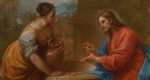
This is the story of a woman who encountered Jesus at the well. She comes to the well in the middle of the noonday heat so as to avoid the other women of her town for fear of encountering their judgment upon her, for she was a sinful woman. At the well she encounters Jesus. Jesus speaks with her for a while and she is deeply touched by this casual but transforming conversation.
The first thing to note is that the very fact of Jesus speaking to her touched her. She was a Samaritan woman and Jesus was a Jewish man. Jewish men did not speak to Samaritan women. But there was something more that Jesus said that deeply affected her. As the woman herself tells us, He “told me everything I have done.”
She wasn’t only impressed that Jesus knew all about her past as if He were a mind reader or magician. There is more to this encounter than the simple fact that Jesus told her all about her past sins. What truly seemed to touch her was that within the context of Jesus knowing all about her, all the sins of her past life and her broken relationships, He still treated her with the greatest respect and dignity. This was a new experience for her!
We can be certain that she would have daily experienced a sort of community shame. The way she lived in the past and the way she was living at the present was not an acceptable lifestyle. And she felt the shame of it which, as mentioned above, was the reason she came to the well in the middle of the day. She was avoiding others.
But here was Jesus. He knew all about her but wanted to give her Living Water nonetheless. He wanted to satiate the thirst that she was feeling in her soul. As He spoke to her, and as she experienced His gentleness and acceptance, that thirst began to be quenched. It began to be quenched because what she really needed, what we all need, is this perfect love and acceptance that Jesus offers. He offered it to her, and He offers it to us.
Interestingly, the woman went away and “left her water jar” by the well. She never actually got the water she came for. Or did she? Symbolically, this act of leaving the water jar at the well is a sign that her thirst was quenched by this encounter with Jesus. She was no longer thirsty, at least spiritually speaking. Jesus, the Living Water, satiated.
Reflect, today, upon the undeniable thirst that is within you. Once you are aware of it, make the conscious choice to let Jesus satiate it with Living Water. If you do this, you too will leave the many “jars” behind that never satisfy for very long.
Lord, You are the Living Water that my soul needs. May I meet You in the heat of my day, in the trials of life, and in my shame and guilt. May I encounter Your love, gentleness and acceptance in these moments, and may that Love become the source of my new life in You. Jesus, I trust in You.
40 Days at the Foot of the Cross – Reflection Eighteen – “This is My Body…This is My Blood”
Autres méditations sur l’Évangile
Méditations sur la Miséricorde divine